

By: Wil Walteros, Director of Citilennial
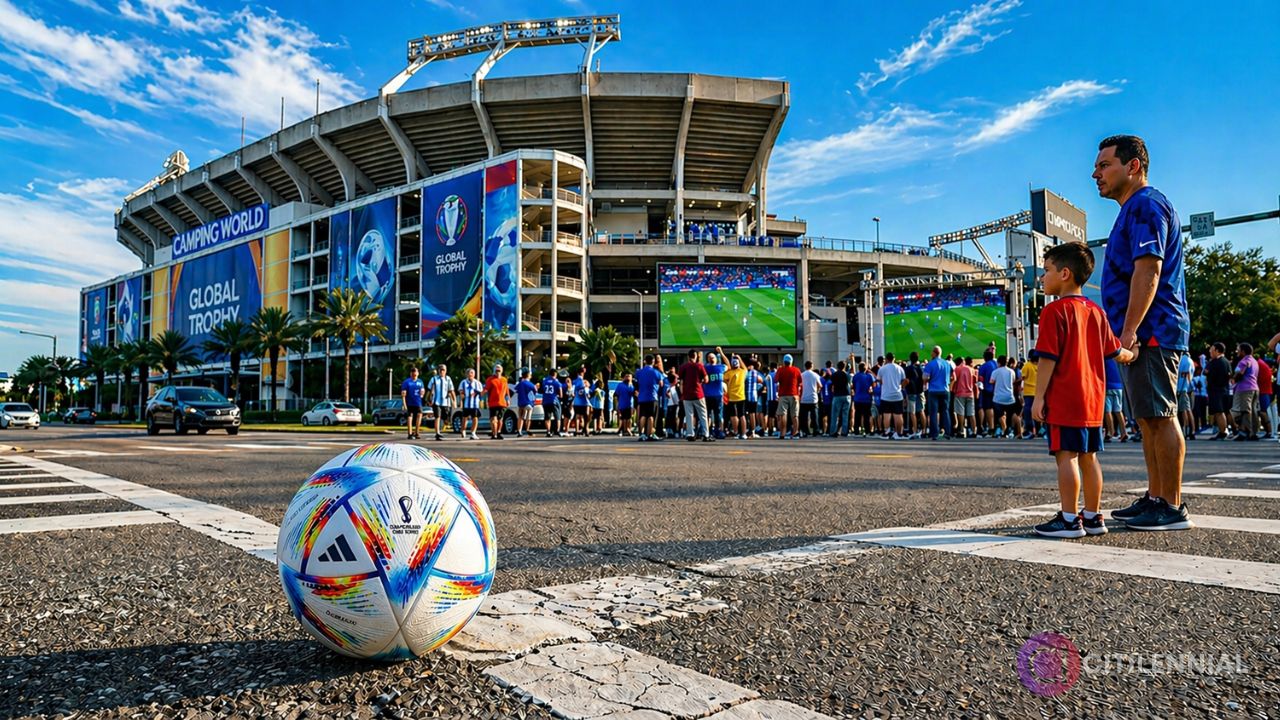
ORLANDO, FL — There are silences that carry more weight than the roar of a packed stadium. A few days ago, my seven-year-old nephew confessed to me, with that purity that survives only in childhood, his newfound love for soccer. I looked at him, and for a moment, I saw myself reflected in his eyes, reminding me of that boy who learned to love this sport while watching his father run across the grass, under the sun, in a bond that knew nothing of transactions, but only of legacy.
That sparkle brings a lump to my throat today because the technical reality—documented in the formal complaint filed by Football Supporters Europe (FSE) with the European Commission—reveals a system that treats passion as if it were a stock on the market. We are facing an “abuse of dominant position” where the original promise of $21 tickets has become a phantom, replaced by a $1,500 price point that excludes the working class and condemns us to a “multi-platform” World Cup. As stadiums become inaccessible sanctuaries, we are left with the consolation of streaming, watching from afar what is happening in our own city.
As Ronan Evain, executive director of FSE, rightly points out: “FIFA is breaking football’s social contract. You can’t organize the world’s biggest tournament while systematically ignoring those who keep it alive: the fans.”
The Clash of Two Worlds: Opportunity or Resource Extraction?
“The irony—and the profound sadness—is that this outrage is taking place on American soil, in the nation that perfected the entertainment industry under a promise that continues to be faithfully upheld: even at the largest events, there is always a place for the average citizen to see their idols. In the NBA, baseball, or the NFL, the mystique of ‘a seat for everyone’ is part of the national identity; this remains the land of opportunity where hard work pays off.
Regarding this disconnect, sports economics analyst Roger Pielke Jr. has been unequivocal: “We are witnessing the culmination of the extreme ‘corporatization’ of sports. FIFA no longer operates as a governing body, but as a private equity firm seeking to squeeze every last penny out of local markets.”
However, the problem isn’t the host, but the guest. FIFA has arrived in North America completely disregarding the continent’s DNA (the United States, Mexico, and Canada are the organizers), imposing a purely exploitative mindset that treats our people as mere variables in a profit-driven algorithm. This disconnect has achieved the unthinkable: a bipartisan consensus in Congress.
A group of 69 lawmakers, bringing together Republicans and Democrats, has denounced this “price gouging” or rampant speculation. For Washington, this isn’t just about money, but an affront to local culture: you can’t come to the land of opportunity and auction off the soul of the sport, jacking up “premium” seats to $10,990 while slamming the door in the face of working families who pay the taxes that support the stadiums and fuel the love for the most popular sport on the planet.
The letter is an initiative led by Representative Sydney Kamlager-Dove (CA-37) along with 69 other U.S. lawmakers.
This official document was sent to FIFA President Gianni Infantino on March 11, 2026. In it, lawmakers express their deep concern over the use of dynamic pricing models, which have caused ticket prices to skyrocket, breaking the original promise to offer tickets starting at $21.
You can view the official statement and the text of the letter on the representative’s office website:
- Link to the press release: Kamlager-Dove Pushes FIFA to Lower World Cup Ticket Prices
- Link to the PDF of the letter: Letter to FIFA re World Cup Ticket Pricing
Key points of the letter:
- Allegations of “Price Gouging”: Lawmakers criticize the use of high demand as an excuse for price gouging at the expense of fans and local communities.
- Impact on Host Cities: They highlight that while FIFA reaps the most lucrative profits, host cities face financial difficulties in organizing free events such as Fan Festivals.
- Call for Transparency: They demand clear answers on how FIFA plans to rectify the damage caused by inflated prices and ensure that the tournament is not an “exclusive event driven solely by profit.”
The Empty Box: Journalism Without an Invitation
As independent journalists with a voice of our own on platforms like Citilennial, we face a double exclusion. We have come up against an impenetrable barrier: access to the Media Hub. FIFA has designed an accreditation process that marginalizes media outlets that are not part of the corporate machine.
I live in Orlando, breathing the air of one of the host cities, but we haven’t been invited to the party. With the press doors closed to independent journalists, our role will be that of chroniclers in exile, poring over pixels because in this new order, if you don’t bring a seven-figure check, you simply don’t exist.
Media expert Jay Rosen’s warning rings true: “When access becomes a commercial privilege, independent journalism is the first to be sacrificed on the altar of the official bulletin.”
Evidence-Based Research
It’s not just a suspicion; it’s a system of exclusion confirmed by investigations by The Athletic. Technical reports reveal that FIFA has implemented misleading seating maps, where availability is manipulated to force the purchase of high-cost tickets, while up to a quarter of the stadium has been reserved for VIP packages, leaving the working class fighting over the scraps of an inventory that the algorithm inflates in real time.
The Death of Economic “Fair Play”
“The criticism isn’t just emotional; it’s a warning about the collapse of the sports model. In a recent analysis by The New Yorker, a devastating question is posed: Is dynamic pricing ruining the World Cup? The answer appears to be a resounding yes. As the article points out, what FIFA has implemented is a form of ‘rent-seeking’ that prioritizes the wallets of the 1% over the loyalty of the 99%.
We are witnessing what experts call the “total commodification” of joy. According to The New Yorker, this pricing system—which fluctuates at the whim of an algorithm—is not only unfair, but also corrosive to soccer culture, transforming a global unifying event into a stock market where passion is the currency and the working-class fan is the asset to be discarded.
The Welcome That Hurts
It’s a painful contradiction: public resources from our cities are being used to host the event, yet taxpayers are being pushed into the virtual realm. Resignation is the organization’s greatest triumph. But soccer was never a private club for millionaires; it was the only thing left for those of us who had nothing else.
I can’t promise my nephew that we’ll be in the stands, or that his uncle will be in the press box covering the story. We’ll probably end up watching the game on three different devices, trying to capture a little of that magic they’ve taken from us. But I can promise him that we won’t let them take away his right to dream without a fight. Because soccer doesn’t belong to whoever has the biggest wallet, but to whoever still believes that a ball can be the center of the universe. If FIFA really wants to “unite the world,” it should start by stopping the auctioning off of soccer’s soul to the highest bidder.
Join the conversation! Let’s not let them turn our heritage into a private club. If you believe soccer should remain the people’s sport, share this investigation and speak out using the hashtags:
#FairPriceFIFA #StopPriceGouging #FútbolParaTodos #WorldCup2026
What’s your story with this World Cup? Leave us a comment below. At Citilennial, your voice is the winning goal we need.
Sources consulted for this research:
Economic Analysis: “Is Dynamic Pricing Ruining the World Cup?” – The New Yorker.
Legislative Action: Bipartisan Letter from 69 Lawmakers to FIFA – U.S. Congress.
Legal Claim: Football Supporters Europe (FSE)- DEMAND.
Technical Research: world-cup-tickets-fans-stadium-seating-map
@wil-walteros